Last night our ship was at anchor in a bay just outside of Fuerte Amador. In the morning a tender took us to the marina in Fuerte Amador where we caught a bus for a tour of Historic and modern Pamama City. Our first stop was the museum where we were shown how the original people lived. Then we visited Panama de Vieja which is the original settlement made in August 15, 1519 by the Spanish conquistador, Petro Aries de Avila. This settlement was destroyed by the infamous Captain Morgan on January 21, 1671 who burnt the city and left with all the riches. We saw the ruins of the original settlement that are now being preserved. Instead of rebuilding the city at the location of the ruins, the city was rebuilt on a peninsula about 8 km from the original location. We visited this location and saw the old buildings and the very narrow streets. We saw in this place a church built with a altar area of gold.
What impressed us most was the new condominium buildings some of which had 80 stories high. Between the codominium buildings and the beach is a wide boulivard called Avida Balboa that has 4 lanes in each direction. This boulivard with the many new condominium building on the other side of the boulivard made a very beautiful looking city.
It was quite hot and muggy during the tour when we were outside. When we finally got back to the ship and had lunch, we had a heavy storm when it rained heavily for about 1 hour and then cleared up. This we were told was the usual weather of Panama City at this time of year.
Modern skyscrapers in downtown Panama City
Con examining ruins of original settlement destroyed by pirate, Captain Morgan
Gold altar that was painted black so pirate, Captain Morgan would not take it.
Cathedral in old Panama City.
Outside wall of former university in the old city
Skyline of new skyscrapers in Panama City.
Dorothy under beautiful flowers in walkway in old city
Narrow shopping street in old city
Cathedral in old city.
Dorothy in front of memorial to builders of Panama Canal.
Our cruise ship, the Veendam at anchor in holding area in front of Panama City.
This diary records the South American cruise that Dorothy and Con Bach made on the Holland America Line cruise ship, the Veendam. The cruise started from New York on October 16, 2011 and terminated in Rio de Janeiro on November 22, 2011. Con and Dorothy stayed in Rio de Janeiro for another 4 days before flying back to their home in Windsor.
Tuesday, 25 October 2011
Monday, 24 October 2011
Oct. 24, 2011 - Panama Canal
What a great day we had to go through the 77.1 KM of the Panama Canal. I got up at 5.30 in the morning as we were scheduled for the first lock at 6 AM. It was a beautiful day as we approached the Gatun Locks. The sun was just rising to a perfectly clear day. We were docked in the first lock by 6.30. This was followed by 2 additional locks to raise us to Gatun Lake that is 85 feet above sea level. Then we anchored as the ships were only allowed to travel in single file in certain sections of the canal because of dredging near the Culegra Cut. We were fortunate in that our passenger ship was given preference to the freighters and lead the line of ships that were headed for the Pacific Ocean. So we crossed Gatun Lake to the famous Culebra Cut and passed under the newly opened Centenniai Bridge. It had not been built the last time Dorothy and I went through the Panama Canal from the opposite direction about 23 years ago. It had been completed in 2004.
Soon after the Centenniai Bridge we got to the single lock called the Pedro Migel Locks that was the first lock to drop us down to the Pacific Ocean. In this area we saw new locks being built that will be able to handle much larger ships in the future. After that we went through the 2 locks of the Mirafieres Locks. This brought us down to the level of the Pacific Ocean.
Our ship moored in the holding area for ships that are to go through the Panama Canal. Tonight and tomorrow people from our ship will catch the tenders to get to Panama City. Dorothy and I are scheduled for a shore excursion by bus of the historic parts and the modern parts of Panama City.
We are well, enjoying ourselves and are looking forward to this shore excursion.
Map of Panama Canal
Entering 1st stage of 3 stage Gatun Locks
Lock gates opening on 2nd. Stage of Gatun Locks
Entering 3rd and final stage of Gatun Locks
Exiting last stage of Gatun Locks to Gatun Lake
Gatun Dam built to form Gatun Lake
Dorothy and Con viewing ships in holding area on Gatun Lake
Passing a ship in the Panama Canal
Large floating crane at maintenance facility at Rio Chargres
Railway Bridge over river from Madden Dam
Dredge working in the Calebra Cut.
New Centenniai Bridge over Calebra Cut.
New canal and locks being built for larger ships.
Entering the single stage Pedro Miguel Locks.
Exiting the Pedro Miguel Locks
Entering the 2-stage Miroflores Locks.
Dam forming lake between the Pedro Miguel Locks and Mireflores Locks
Entering the 2-stage Miroflores Locks.
Entering last stage of Miroflores Locks
Bridge of the Americas over the entrance of the Panama Canal
Soon after the Centenniai Bridge we got to the single lock called the Pedro Migel Locks that was the first lock to drop us down to the Pacific Ocean. In this area we saw new locks being built that will be able to handle much larger ships in the future. After that we went through the 2 locks of the Mirafieres Locks. This brought us down to the level of the Pacific Ocean.
Our ship moored in the holding area for ships that are to go through the Panama Canal. Tonight and tomorrow people from our ship will catch the tenders to get to Panama City. Dorothy and I are scheduled for a shore excursion by bus of the historic parts and the modern parts of Panama City.
We are well, enjoying ourselves and are looking forward to this shore excursion.
Map of Panama Canal
Entering 1st stage of 3 stage Gatun Locks
Lock gates opening on 2nd. Stage of Gatun Locks
Entering 3rd and final stage of Gatun Locks
Exiting last stage of Gatun Locks to Gatun Lake
Gatun Dam built to form Gatun Lake
Dorothy and Con viewing ships in holding area on Gatun Lake
Passing a ship in the Panama Canal
Large floating crane at maintenance facility at Rio Chargres
Railway Bridge over river from Madden Dam
Dredge working in the Calebra Cut.
New Centenniai Bridge over Calebra Cut.
New canal and locks being built for larger ships.
Entering the single stage Pedro Miguel Locks.
Exiting the Pedro Miguel Locks
Entering the 2-stage Miroflores Locks.
Dam forming lake between the Pedro Miguel Locks and Mireflores Locks
Entering the 2-stage Miroflores Locks.
Entering last stage of Miroflores Locks
Bridge of the Americas over the entrance of the Panama Canal
Sunday, 23 October 2011
Oct. 23, 2011 - San Blas Island
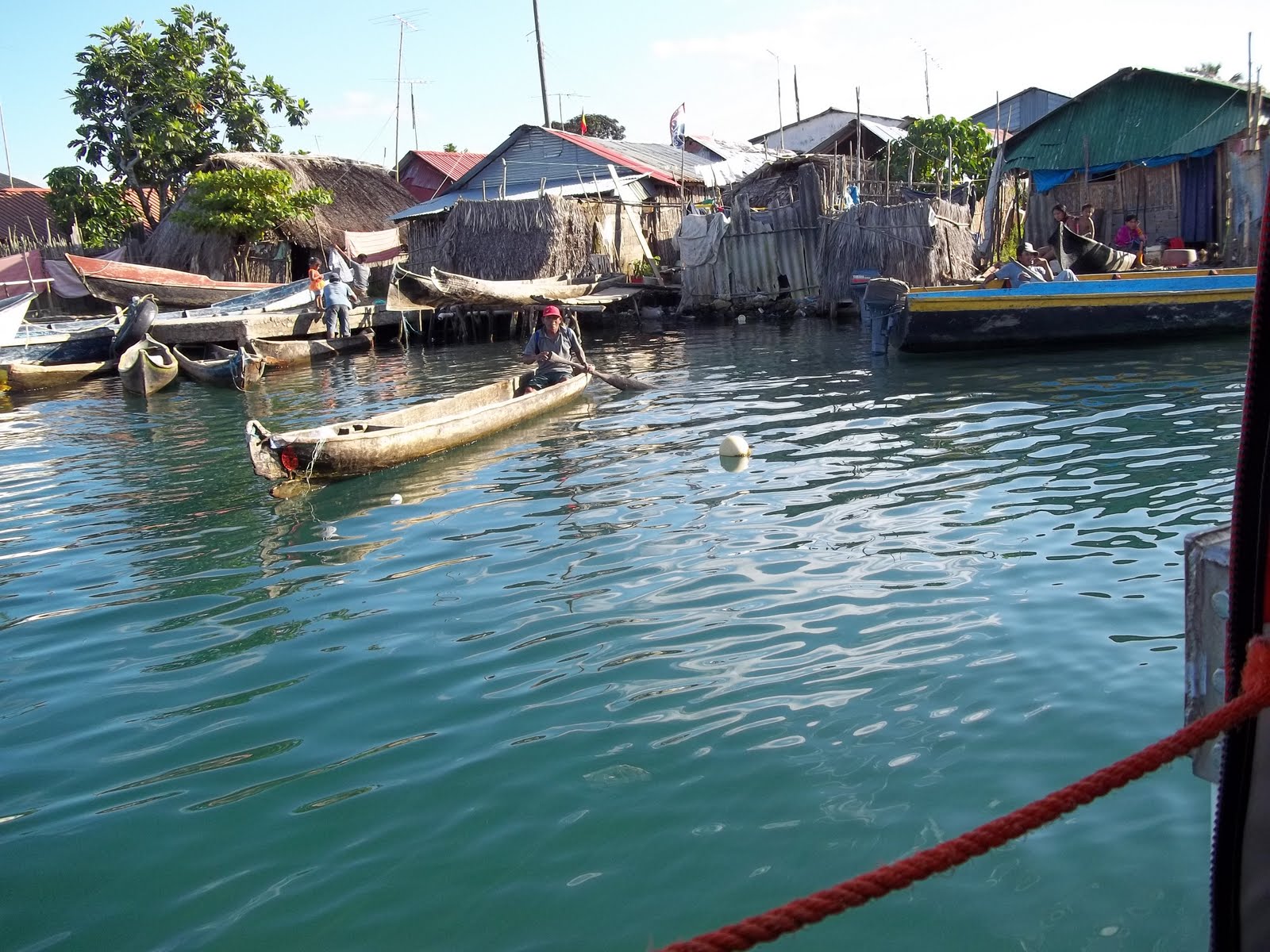
This morning we arrived at the San Blas Archipelago that is just east of Cristobal that is at the entrance of the Panama Canal. The San Blas Archipelago consists of over 365 islands strung along the Panama's north coast. In the morning we cruised by many of these islands. Only about 50 of the islands are inhabited. The islands are covered with palm trees even though some of them are quite small.
We arrived at Sug Tupu island at about 11 AM and this is the island that we were to be ferried to by the ships tenders. When we arrived the young Cuna men and boys came out in their dugout wooden canoes and dove for coins as we tossed them overboard. This was something to see and we were all taken up by the skill of the men to retrieve the coins tossed into the water
Dorothy and I had a ticket to go over to the island for 3 PM and had to make sure we caught the last tender that was to depart at 5.30 PM. The ship was scheduled to leave by 6 PM.
The island was very interesting. It was inhabited by the Cuna tribes that have a unique language and heritage. They are subjects of Panama but are allowed to follow their traditional way of life. Once on the island we were amazed at all the people trying to sell their wears or have their pictures taken for $1. Dorothy bought 2 interesting conc shells.
We also were shown a family unit by a man who had worked in the mess of the US army when it was still in Panama. He showed us how his family and relatives lived in a small community. We saw many of the elder women wearing their traditional dresses with their Mola blouses. They were very colourful and of course were also selling these Molas.
We stayed on the island for about an hour and we were happy to get back to the ship and enjoy our way of life on the ship.
We departed at 6 PM just as the sun was setting. Tomorrow we will be going through the Panama Canal.
Some of the 350 islands in the San Blas Archipelago
Cuna young men waiting for coins to be thrown from the ship
3 Cuna men dive for coins
Cuna family in a large dug-out canoe.
Docking area for Cuna boats at Sug Tupu Island
Dorothy at the stall in the market on Sug Tupu Island
Lady in traditional native dress with Mola blouse
High tech microwave antenna for TV and internet on Sug Tupu Island
School room in Cuna village on the island
Toilet over the water at end of a jetty
Cuna man who showed where he and his family lived on Sug Tupu Island
Dorothy and Con in Cuna village on Sug Tupu Island.
Sugar cane juice is being squeezed from a sugar cane
Docking area for Cuna boats on Sug Tupu
Large yacht moors outside Sug Tupu Island
We arrived at Sug Tupu island at about 11 AM and this is the island that we were to be ferried to by the ships tenders. When we arrived the young Cuna men and boys came out in their dugout wooden canoes and dove for coins as we tossed them overboard. This was something to see and we were all taken up by the skill of the men to retrieve the coins tossed into the water
Dorothy and I had a ticket to go over to the island for 3 PM and had to make sure we caught the last tender that was to depart at 5.30 PM. The ship was scheduled to leave by 6 PM.
The island was very interesting. It was inhabited by the Cuna tribes that have a unique language and heritage. They are subjects of Panama but are allowed to follow their traditional way of life. Once on the island we were amazed at all the people trying to sell their wears or have their pictures taken for $1. Dorothy bought 2 interesting conc shells.
We also were shown a family unit by a man who had worked in the mess of the US army when it was still in Panama. He showed us how his family and relatives lived in a small community. We saw many of the elder women wearing their traditional dresses with their Mola blouses. They were very colourful and of course were also selling these Molas.
We stayed on the island for about an hour and we were happy to get back to the ship and enjoy our way of life on the ship.
We departed at 6 PM just as the sun was setting. Tomorrow we will be going through the Panama Canal.
Some of the 350 islands in the San Blas Archipelago
Cuna young men waiting for coins to be thrown from the ship
3 Cuna men dive for coins
Cuna family in a large dug-out canoe.
Docking area for Cuna boats at Sug Tupu Island
Dorothy at the stall in the market on Sug Tupu Island
Lady in traditional native dress with Mola blouse
High tech microwave antenna for TV and internet on Sug Tupu Island
School room in Cuna village on the island
Toilet over the water at end of a jetty
Cuna man who showed where he and his family lived on Sug Tupu Island
Dorothy and Con in Cuna village on Sug Tupu Island.
Sugar cane juice is being squeezed from a sugar cane
Docking area for Cuna boats on Sug Tupu
Large yacht moors outside Sug Tupu Island
Oct. 22, 2011 - Santa Marta, Columbia
We docked at Santa Marta at 8 AM right on the scheduled time. I think the Captain once worked for a railway on the way he keeps to a schedule.
We went on a bus tour of Santa Marta that included Folk Dancing on a beach. We started with a tour through the old section of Santa Marta. This was interesting as Santa Marta was established on July 29, 1525 by the Spanish conqueror Rodrigo de Bastidas. This makes it the oldest remaining city in Columbia. Then we went to a very beautiful park that once was the estate of Quinta de San Pedro Alejandrino. He allowed the Liberator of Columbia, Simon Bolivar to stay there till he died on December 17, 1830 when this famous liberator became penniless. This estate is now a memorial to Simon Bolivar. Besides the memorial, the park is very beautiful with very old trees and gardens.
Next we drove about 40 KM down the coast to a resort where we saw Folk Dancing. After that we returned to old Santa Marta and were taken to the museum where we saw displays of the original people of this area, their jewelry and how they lived. After this we saw the famous Santa Marta Cathedral that dates back to the time Santa Marta was originally established. We walked through the very old streets of Santa Marta and saw many very old buildings. This was a great day and Dorothy and I enjoyed it thoroughly.
The bed where the famous liberator of Columbia, Simon Bolivar died
A very old tree on the estate of Quinta de San Pedro Alejandrino where Simon Bolivar died
Memorial building for Simon Bolivar
Dorothy in front of the memorial to Simon Bolivar
Folk dancers
The beach about 40 km’s from Santa Marta where the folk dancers performed
Santa Marta with our cruise ship in the harbor.
Dorothy in front of the cathedral in Santa Marta
Pretty building at the city square.
Another old building on the city square
We went on a bus tour of Santa Marta that included Folk Dancing on a beach. We started with a tour through the old section of Santa Marta. This was interesting as Santa Marta was established on July 29, 1525 by the Spanish conqueror Rodrigo de Bastidas. This makes it the oldest remaining city in Columbia. Then we went to a very beautiful park that once was the estate of Quinta de San Pedro Alejandrino. He allowed the Liberator of Columbia, Simon Bolivar to stay there till he died on December 17, 1830 when this famous liberator became penniless. This estate is now a memorial to Simon Bolivar. Besides the memorial, the park is very beautiful with very old trees and gardens.
Next we drove about 40 KM down the coast to a resort where we saw Folk Dancing. After that we returned to old Santa Marta and were taken to the museum where we saw displays of the original people of this area, their jewelry and how they lived. After this we saw the famous Santa Marta Cathedral that dates back to the time Santa Marta was originally established. We walked through the very old streets of Santa Marta and saw many very old buildings. This was a great day and Dorothy and I enjoyed it thoroughly.
The bed where the famous liberator of Columbia, Simon Bolivar died
A very old tree on the estate of Quinta de San Pedro Alejandrino where Simon Bolivar died
Memorial building for Simon Bolivar
Dorothy in front of the memorial to Simon Bolivar
Folk dancers
The beach about 40 km’s from Santa Marta where the folk dancers performed
Santa Marta with our cruise ship in the harbor.
Dorothy in front of the cathedral in Santa Marta
Pretty building at the city square.
Another old building on the city square
Oct. 21, 2011 - Cruising from about Cuba to Santa Marta
I tried last night to update you on this day's activity but the internet connection was not working too well. When I got up at about 6 AM, I walked out on deck and saw Haiti on the left had side (port) of the ship. It was a very clear morning so I saw Haiti very clearly. Later in the morning, Dorothy and I attended a very interesting lecture on the 4 voyages of Columbus to the areas that we were just sailing through. After we passed Haiti we passed Jamacia but it was too far to the west to see from the ship.
Friday, 21 October 2011
Oct.20, 2011 - Cruising from Fort Lauderdale to Santa Marta
We left Fort Lauderdale at about 5 PM on Oct 19 and headed south in the direction of Cuba. Soon after sunrise on Oct. 20, I saw some of the outer islands of Cuba that are north of Las Tunas in Cuba. We cruised in an easterly direction just north of Cuba and could see the mountains of Cuba. At sunset we could not see Cuba but knew that the ship was heading to the passage between the eastern end of Cuba and the western side of Haiti.
At night we had a formal evening when we dressed into our long dresses for the ladies and tuxidos for the men. We all looked rather grand and were given a great dinner to complement our dress. After dinner we saw a Broadway show with singers and dancers that had been on Broadway. This was an exceptional show that we enjoyed thoroughly.
Dorothy and Con at sea just north of Cuba
Dorothy and Con at their first formal dinner on the ship
People enjoying the pool in hot weather just north of Cuba
At night we had a formal evening when we dressed into our long dresses for the ladies and tuxidos for the men. We all looked rather grand and were given a great dinner to complement our dress. After dinner we saw a Broadway show with singers and dancers that had been on Broadway. This was an exceptional show that we enjoyed thoroughly.
Dorothy and Con at sea just north of Cuba
Dorothy and Con at their first formal dinner on the ship
People enjoying the pool in hot weather just north of Cuba
Subscribe to:
Posts (Atom)